
3D Printed nasopharyngeal (NP) Test Swabs


3D Printed nasopharyngeal (NP) Test Swabs for COVID-19.
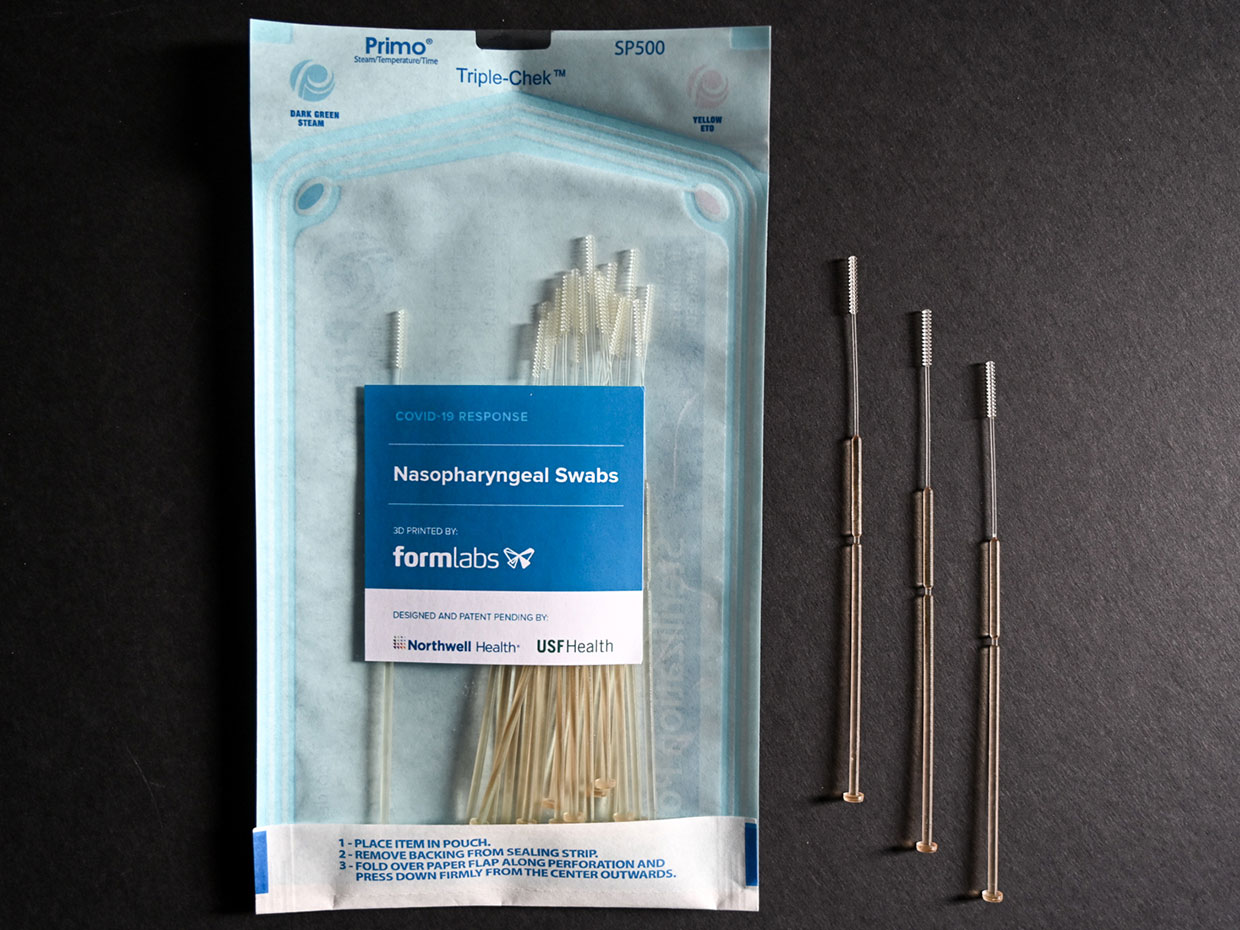
The most common diagnostic test currently used for detecting the coronavirus in mucous samples is PCR, a polymerase chain reaction test that can detect nucleic acid from SARS-CoV-2 in respiratory specimens. In order to conduct this test nasopharyngeal (NP) test swabs are needed. There is a shortage of the nasopharyngeal (NP) swabs needed to collect samples for COVID-19 testing. These swabs are typically used for testing for influenza and other respiratory infections. The current and impending supply chain shortages are serious enough that clinicians are beginning to design and test their own swabs as quickly and safely as possible.  For example, a 3D Printed nasopharyngeal (NP) Test Swabs. Medically recognized SLA 3D printing systems and materials—commonly used in the dental industry—have been adapted to fulfill production of nasal swabs. The resin-based process offers high-resolution printing, which is needed for the fine components, while bio-compatible materials that have already undergone certification for dental applications can be used right away.
NP swabs overview:
NP swabs are flexible sticks with a bristled end that are inserted into the nose to the back of the nasal cavity and swept around to collect material that sticks to or wicks up the bristles. The swab is then placed into a vial that contains a culture medium. Swab sticks have an intentionally weak point 7–8 cm from the bristled tip, which allows the stick to be broken to the correct length so that the vial can be capped before it is transported to a laboratory for testing.  


references: 

The design link:


Comments

Popular posts from this blog

New ventilator mask protects entire face from coronavirus

https://www.israel21c.org/new-ventilator-mask-protects-entire-face-from-coronavirus/ Many people are wearing facemasks to avoid breathing airborne coronavirus particles, and to keep from touching their noses and mouths. However, even N95 masks can’t fully block tiny virus particles and can’t kill the virus (two masks  under development in Israel  aim to do that). Any blocked viral particles stay on the mask’s surface and pose a hazard when handled and thrown away. Furthermore, facemasks don’t cover eyes. Although the nose is the main route for coronavirus into the lungs,  some researchers believe  the eye’s conjunctiva is another possible point of entry. That’s why Israeli physician and serial medical-device inventor Dr. Noam Gavriely worked quickly to develop what he calls the  ViriMASK Protective Oculo-Respirator . ViriMASK is strapped around the head, covering the eyes with a see-through visor and the nose and mouth with a filtering mechanism....
Patient Isolation Stretcher Cover PPE to be used while transporting the patient with infectious disease in ambulance or within hospital. The plastic cover can be made with transparent TPU or 16 gauge clear vinyl material and the rods from 1/2 inch ABS pipes. The overall dimensions are kept as 2mx0.6mx0.6m. Plastic zippers to be attached on the sides of the fattened plastic. 8 4" wide glove ports are provided for attaching nitrile gloves on the sides. For air circulation - At the inlet, use 2 HEPA filters 0.3micrometer, 99.99% or more. At the outlet, use HEPA filter along with filters for biological substances. In the Exhaust box, use one way valve and exhaust fan. Usually a 5CFM exhaust fan will provide a ventialtion of 12 times per hour for this volume of containment. A 12 Volt battery is used to power the exhaust unit. A pouch can be attached to the canopy, for holding the battery link: https://grabcad.com/library/patient-isolation-stretcher-cover-1

HealthyPi

  The HealthyPi was designed with not just one application in mind, but a variety of them. While it does function as a vital sign monitor for traditional patient monitoring applications, it can also be used for several other applications. You can use it with a Raspberry Pi using a display; use it with a Raspberry Pi with the official touchscreen using our “Complete Kit,” or you can use it standalone by connecting it to any computer’s USB port. The software is compatible across all platforms.                                                                         Resources: https://github.com/Protocentral/protocentral-healthypi-v3 http://healthypi.protocentral.com